The Soft Weight of History: Cotton, Gold, and the Art of Repair
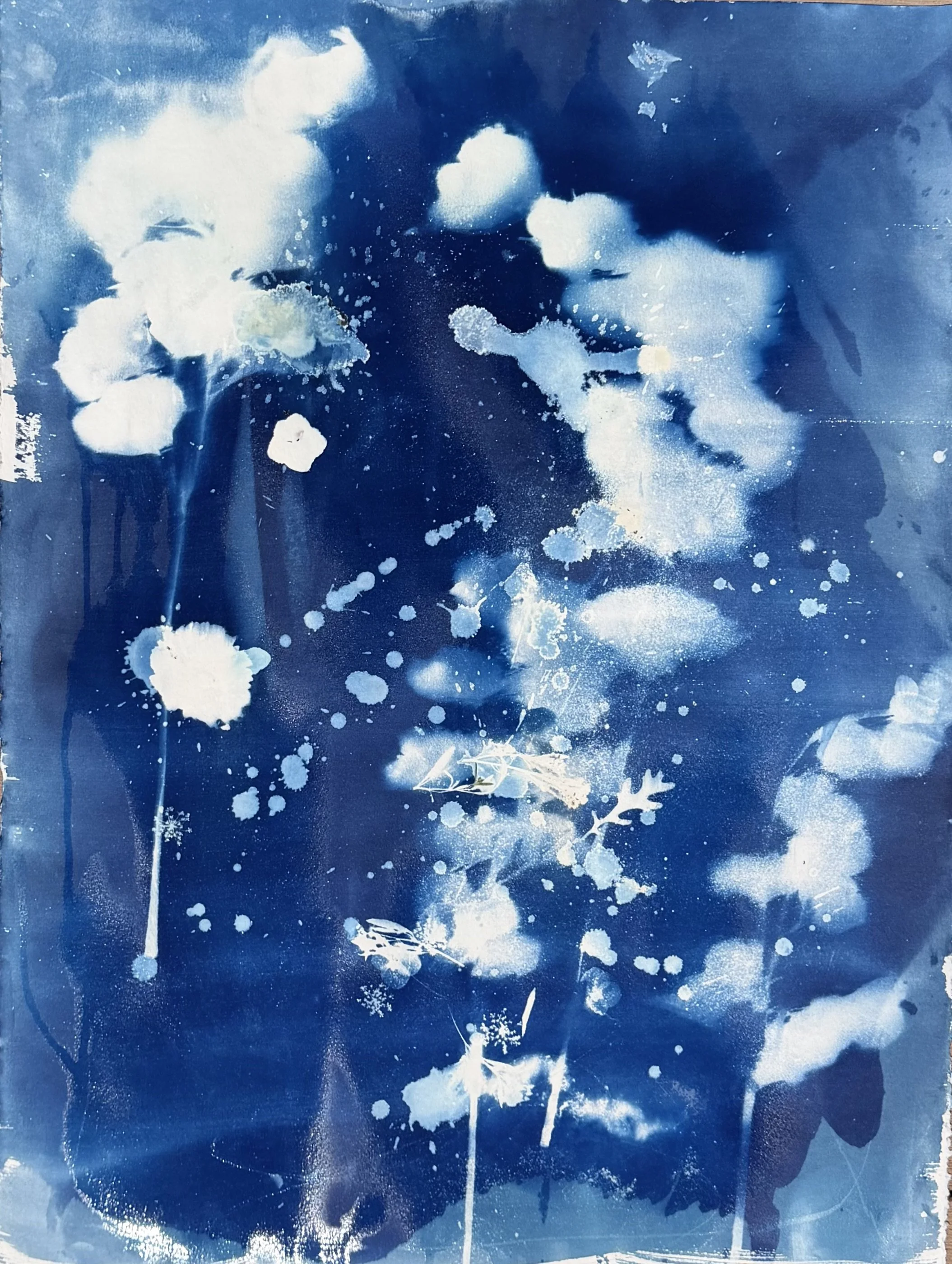
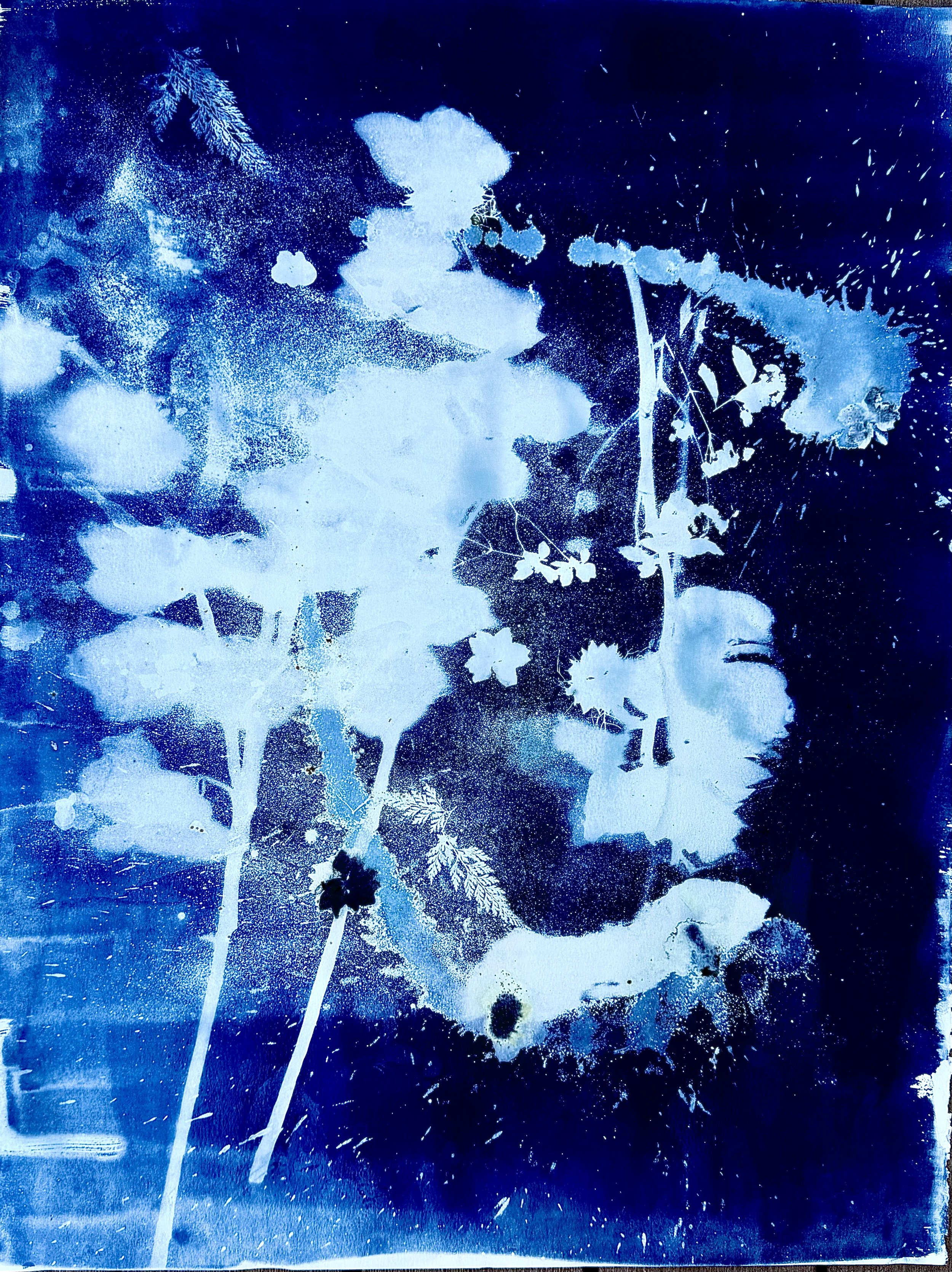
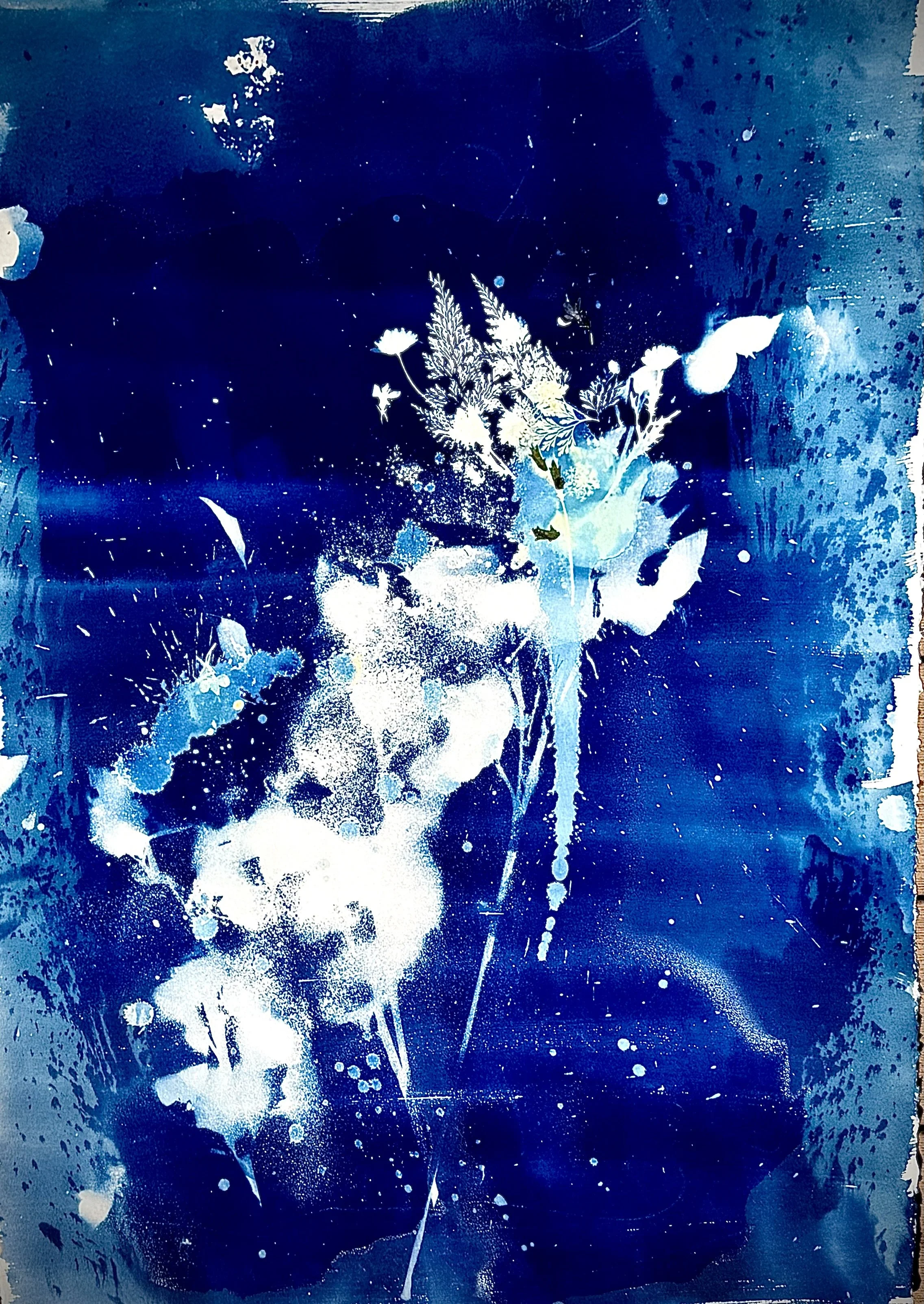
As this body of work continues to evolve, I find myself moving further away from photography as documentation and closer to photography as ritual. These new 20” × 30” cyanotypes represent another step in that journey. While my earlier pieces centered on portraiture, these works begin with something far quieter: cotton blooms gathered by hand, scattered botanicals, pools of cyanotype chemistry, and sunlight. They are less about seeing a person and more about witnessing an inheritance.
When I first laid the cotton branches across the sensitized paper, I was struck by the contradiction they carried. Cotton is one of the softest materials we know. We wrap newborns in it. We sleep beneath it. We wear it against our skin every day without thinking twice. Yet behind that softness is one of the hardest histories imaginable. Cotton is impossible to separate from the legacy of slavery, forced labor, economic power, colonial expansion, and the lives of millions whose stories have too often been reduced to statistics instead of remembered as people.
As a Black woman, I cannot look at cotton without seeing both beauty and burden. I cannot touch its softness without feeling the weight of those who harvested it before me. Yet I also refuse to surrender the plant entirely to its painful history. Nature itself is innocent. Cotton did not create oppression; people did. The plant continues to bloom every season, unaware of the histories projected onto it. That realization became the beginning of this work.
These pieces ask what it means to reclaim a material without erasing its past. They ask whether beauty can coexist with historical truth. Rather than illustrating trauma, I want these cyanotypes to hold space for complexity. The cotton branches stretch across the paper like family trees, each boll opening into delicate white clouds that seem to float against the deep blue of the cyanotype. They are simultaneously flowers, wounds, stars, and memories. They become constellations that connect generations.
The cyanotype process itself mirrors that conversation. Every sheet begins as a pale green surface coated with chemistry, seemingly empty of meaning. I carefully arrange the cotton alongside dried wildflowers, grasses, seed pods, and fragments collected during long walks. Nothing is placed casually. Each botanical becomes a participant in the composition, carrying its own history of growth, bloom, decay, and renewal. Once the glass is lowered, the entire arrangement is surrendered to the sun.
There is a quiet tension during exposure. The plants cast shadows while the ultraviolet light slowly transforms the chemistry beneath them. I cannot rush the process. I cannot negotiate with the weather. The sun decides when the work is complete. That surrender has become one of the most important lessons this series has offered me. After years of believing that healing required effort, productivity, and certainty, these cyanotypes remind me that transformation often arrives through patience instead.
When the paper is washed, the cotton disappears.
What remains is only its memory.
The physical branch is lifted away, but its silhouette stays embedded within the fibers of the paper. That feels deeply symbolic to me. History works the same way. The people who came before us may no longer be physically present, but their imprint remains. Their labor, their resilience, their grief, and their joy continue to shape the landscape we inherit. The cyanotype becomes both photograph and fossil, preserving evidence of something that once occupied that space.
Looking closely at these prints, I find myself drawn to the accidental moments. Chemistry blooms into galaxies. Water stains resemble rivers viewed from above. Tiny droplets explode into stars. The cotton seems to drift through space rather than rest upon paper. These moments cannot be planned. They emerge from collaboration between artist, chemistry, water, gravity, and light. Increasingly, I think of myself less as the maker and more as the facilitator of these encounters.
The next stage of this work will introduce gold.
Not gold as ornament, but gold as language.
Inspired by the Japanese philosophy of kintsugi, I will begin drawing directly onto these cyanotypes with gold, following the imagined fractures that run through each composition. Traditionally, kintsugi is the practice of repairing broken ceramics with lacquer mixed with precious metal, making the break visible rather than disguising it. The repaired object becomes more valuable because of its history, not despite it.
I have always loved that philosophy, but I am less interested in replicating the traditional technique than in translating its spirit into photography. These cyanotypes are not physically broken, yet they carry invisible fractures. They speak of inherited histories, personal grief, illness, reinvention, displacement, and healing. The gold will not hide those fractures. It will reveal them.
Rather than drawing arbitrary decorative lines, I plan to respond intuitively to each composition. The pathways of gold will move through the silhouettes of cotton, connect isolated botanical forms, and trace the organic chemistry left behind by water and sunlight. In some places, the gold may resemble roots pushing through soil. In others, rivers finding their course, veins carrying life, or maps connecting one generation to another. Each mark will become a gesture of repair—not a repair that restores things to how they once were, but one that honors transformation itself.
I keep returning to the idea that repair is not the same as restoration.
Restoration attempts to erase evidence that something was ever damaged. Repair acknowledges what happened and chooses to move forward without pretending the past did not exist. That distinction feels increasingly important in my own life and in the histories these materials carry. None of us return to who we once were after loss. We become someone new. The gold simply makes that becoming visible.
Together, the cyan blue, the ghostly impressions of cotton, the preserved botanicals, and the hand-drawn gold will form a conversation between land, memory, ancestry, and healing. Blue becomes the language of water, sky, and spirit. White becomes memory. Gold becomes resilience.
These works are not simply about cotton.
They are about inheritance.
They are about asking what we choose to carry forward, what we choose to transform, and how beauty can emerge not by forgetting history, but by remaining in conversation with it.
As I continue this series, I realize that I am no longer trying to make photographs that describe the world as it appears. I am trying to make photographs that feel like memory itself—fragmented, luminous, layered with time, and forever touched by the people who came before us.
Perhaps that is what catharsis has always been: not washing the past away, but allowing light to reveal where the gold belongs.