Catharsis in Blue: Finding My Way Home Through Cyanotype
There are moments in an artist’s life when the work stops being about making beautiful objects and begins asking something much deeper. It asks for honesty. It asks for surrender. It asks for the courage to transform experiences that once felt unbearable into something that can be held with gentleness. This new body of cyanotypes was born from that place.
For much of my life, photography has been a way of preserving moments before they disappeared. As the daughter of a photographer, I learned early that the camera could become both witness and archive. It could hold memory long after people, places, and even feelings had changed. But over the past year, I found myself longing for photography to do something more than preserve. I needed it to heal.
These cyanotypes emerged during a period of profound transition. They carry traces of grief, recovery, reinvention, and the quiet work of rebuilding a life after illness, loss, and unexpected endings. Rather than documenting those experiences directly, I wanted to create images that felt the way healing actually feels—layered, imperfect, unpredictable, and deeply connected to the natural world.
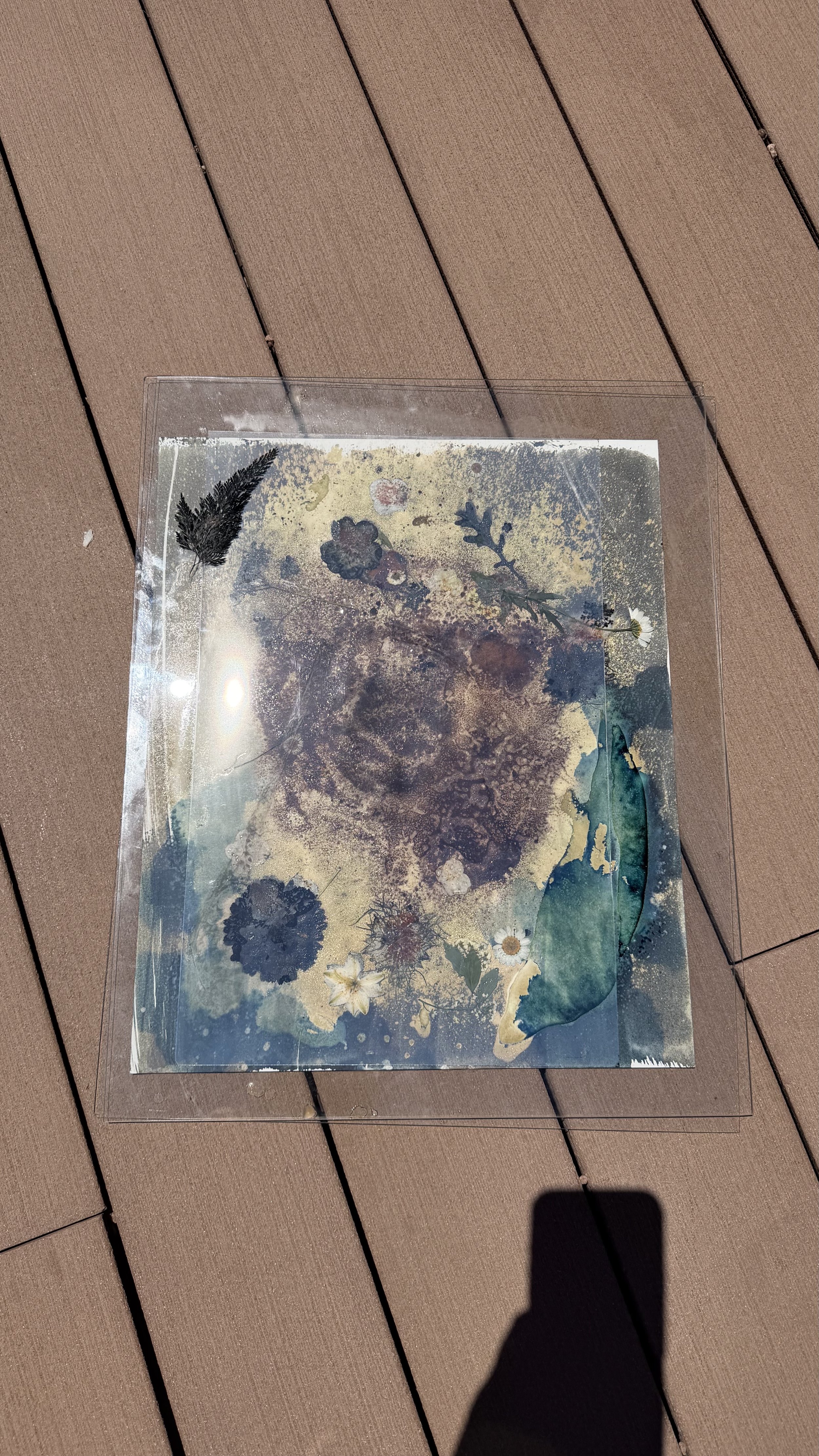
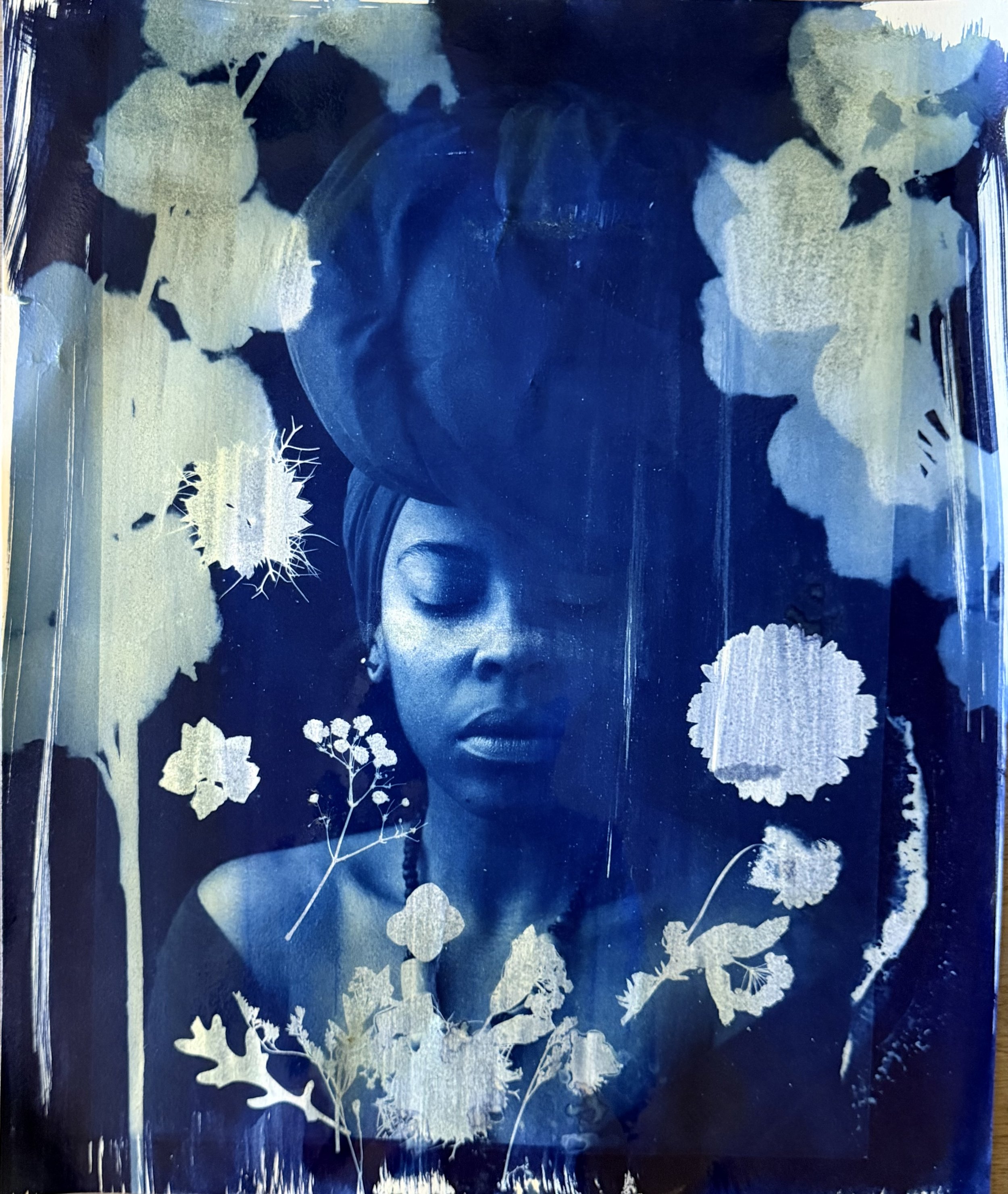
The process begins with one of my photographic portraits. Traditionally, a photograph captures a singular moment in time, freezing it before it disappears. In this work, however, the portrait is only the beginning. I intentionally relinquish its permanence. Once coated with cyanotype chemistry and exposed to sunlight, the original image begins to dissolve into something less literal and far more emotional. The photograph is no longer asked to describe a person. Instead, it becomes a vessel capable of carrying memory, vulnerability, and transformation.
Working with cyanotype has become an act of meditation. There is something profoundly humbling about using one of photography’s oldest processes, one that depends almost entirely upon forces beyond my control. I can prepare the paper, carefully arrange the botanicals, expose the work to the sun, and wash the print in water, but the chemistry always has the final word. Every brushstroke leaves evidence of my hand. Every change in sunlight alters the outcome. Water creates blooms and textures I could never intentionally paint. The process continually reminds me that control is an illusion, and perhaps that is precisely why I keep returning to it.
As I began making these prints, I found myself collecting plants differently. Flowers that had already bloomed and faded became more interesting than perfect blossoms. Seed heads, dried stems, delicate leaves, and wild botanicals all carried evidence of time. They were no longer symbols of life at its beginning, but of life continuing after transformation. Pressing these plants into the cyanotypes felt like inviting another kind of memory into the work—one rooted in cycles rather than endings.
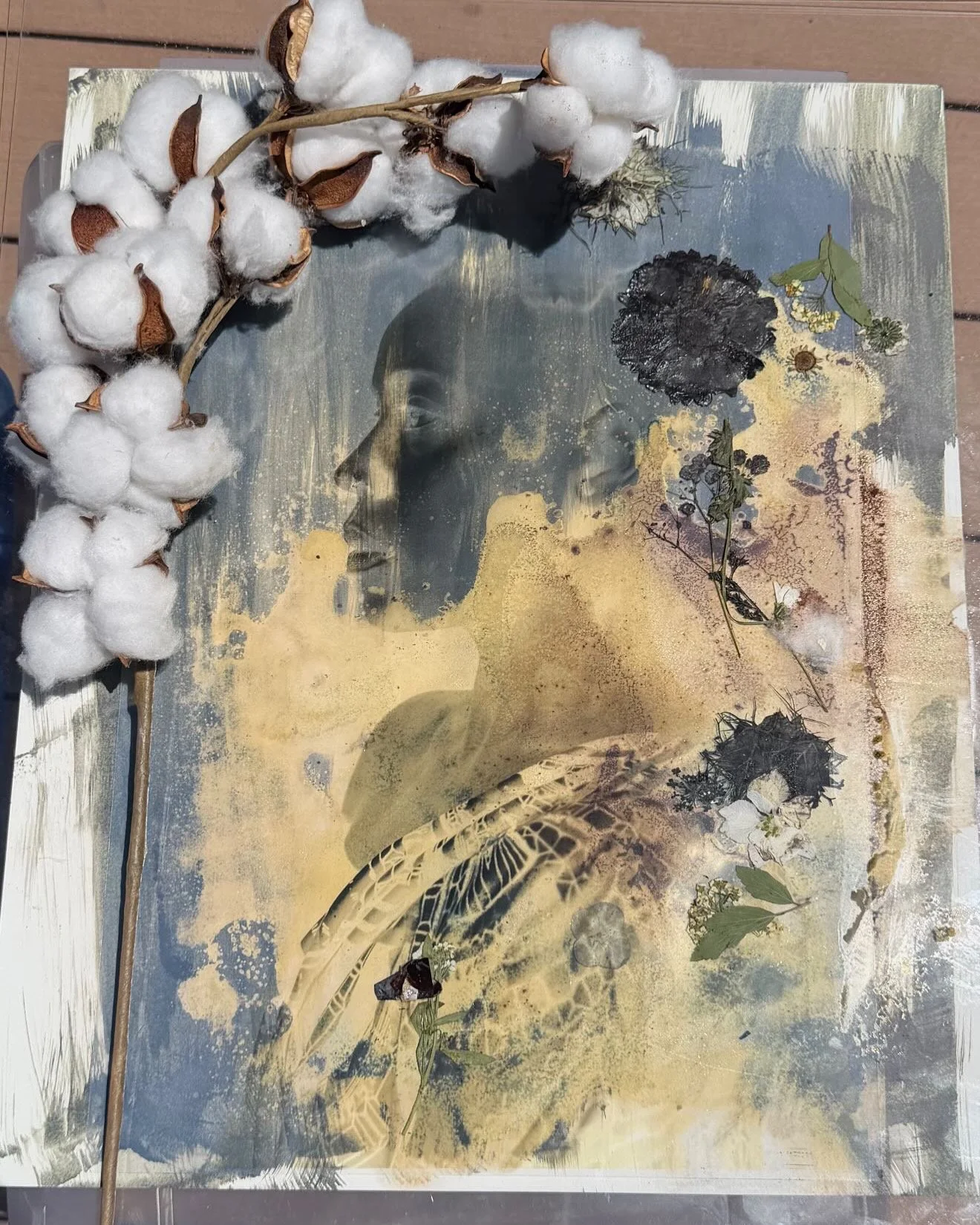
Cotton entered the series almost unexpectedly, but quickly revealed itself to be essential. On its surface, cotton is soft, comforting, and familiar. Yet it also carries an immeasurable historical weight. It speaks to labor, resilience, ancestry, exploitation, survival, and the complicated history that shaped generations before me. Incorporating cotton into these works is not intended as decoration. It serves as a quiet acknowledgment that beauty and pain often exist together. The same plant that symbolizes comfort also asks us to remember the people whose hands cultivated it, whose lives became intertwined with its history, and whose stories continue to echo through the present. By allowing cotton to frame these portraits, I am acknowledging both inheritance and resilience, recognizing that our histories cannot be separated from our identities.
Throughout this series, I became less interested in creating flawless images and more interested in allowing the materials to reveal their own truths. The streaks left by the brush, the uneven chemistry, the bleeding edges, and the accidental marks are no longer imperfections to correct. They have become evidence of the process itself. Much like our own lives, these prints are beautiful because they bear the marks of what they have survived.
I have come to understand catharsis not as the release of pain, but as the transformation of it. We rarely leave our hardest experiences behind. Instead, we learn how to carry them differently. These cyanotypes embody that realization. Rather than erasing grief, they allow it to become one layer among many. Joy, memory, ancestry, beauty, loss, tenderness, and hope all occupy the same space. None cancels out the others. Together, they create something richer than any single emotion could hold.
Perhaps my favorite collaborator throughout this process has been the sun itself. After arranging each composition, there comes a moment when I can do nothing more. The paper is exposed to light, and I simply wait. Clouds move overhead. Time passes. Nature participates in ways I cannot predict or control. There is something profoundly healing about relinquishing authorship to light, about trusting that what emerges will be exactly what it is meant to become.
When I look at these finished works, I no longer see portraits in the traditional sense. I see landscapes of becoming. The faces are not simply representations of individuals; they become places where memory, nature, history, and spirit converge. The deep blue of the cyanotype no longer feels melancholic to me. Instead, it evokes water, sky, breath, and infinite possibility. It has become the color of healing—not because healing is easy, but because it asks us to move through depths we never imagined we could navigate.
My hope is that these works invite viewers to slow down. In a culture that often asks us to move quickly past discomfort, these cyanotypes encourage a different pace. They ask us to sit with complexity, to recognize beauty in imperfection, and to honor the ways our lives are continually shaped by both what we inherit and what we choose to transform.
In many ways, this series marks the beginning of a new chapter in my artistic practice. It is a return to photography, but one that embraces experimentation rather than certainty. It is a return to the land, to plants, to sunlight, to handmade processes that require patience instead of speed. Most importantly, it is a return to myself not the version shaped by expectation or perfection, but the one willing to trust that healing, like a cyanotype, is developed slowly, through light, water, and time.
These works are not about documenting who I have been. They are about honoring the person I am still becoming.