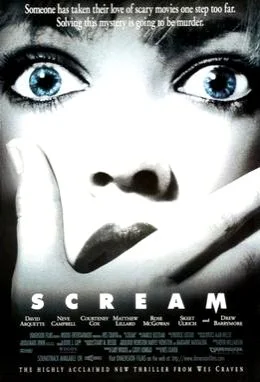
Hellah Horrah Presents: Scream
It Started as a Love Story
Boooo-ha-ha-ha, my sharp-tongued scream queens and gore-geous ghouls—Hellah Horrah here, dialing straight into your nightmares (and your caller ID). Tonight’s feature? The slasher that slashed differently, the film that whispered “I love you” before it gutted you: Scream (1996).
Yes, you heard me right. It started as a love story.
Love, Actually (Is Terrifying)
At its heart, Scream is about romance gone rancid. Billy Loomis, the bad-boy boyfriend with eyebrows sharp enough to cut glass, whispers sweet nothings into Sidney Prescott’s ear. But behind those dreamy eyes? A stalker’s alibi. He doesn’t just break her heart—he weaponizes it. And that, my pretties, is the most horrifying love story of all: when devotion mutates into destruction.
Sidney wants trust. Billy offers trauma. Cupid’s arrow? More like Cupid’s hunting knife.
The Courtship of Carnage
But romance isn’t the only relationship on display—Scream is a full-on soap opera soaked in blood.
Sidney & Tatum: Ride-or-die BFFs who prove that friendship can survive curfews but not garage doors.
Gale & Dewey: She’s ambition in heels, he’s a deputy with a badge too big for his britches. Their banter blooms into something real, across sequels, reboots, and re-reboots. (Horror’s longest-running rom-com, anyone?)
Fans & Tropes: Randy, our video-store prophet, reminds us that slashers are a dialogue with their own audience. The horror genre woos us, betrays us, and woos us again. Meta is the new marriage contract.
A Love Letter to Horror
Don’t mistake the satire for mockery—Scream isn’t laughing at horror, it’s flirting with it. Every rule Randy rattles off is a kiss on the cheek to the movies that came before. No sex, no booze, no “I’ll be right back”? That’s just foreplay, darlings. Wes Craven knew the genre so intimately he could undress it, stitch it back together, and make us fall in love all over again.
And let’s not forget: the opening scene with Drew Barrymore is itself a twisted courtship. Ghostface teases, flatters, asks personal questions like it’s a Tinder date gone terribly wrong. Only instead of dinner and a movie, it’s popcorn and a home invasion.
Why We Keep Answering the Call
The reason Scream endures—through sequels, reboots, requels—is because it knows what horror really is: not just fear of dying, but fear of loving. Fear of intimacy, of trust, of the masks we put on for each other. Every call from Ghostface is a Valentine—signed in blood, sealed with a scream.
And yet… we can’t help but pick up the phone. Again and again. Because deep down, we know it’s not just a killer on the line. It’s horror itself, calling to remind us why we fell in love in the first place.
So, What’s Love Got to Do With It?
Everything. Scream is a bouquet of roses with thorns sharp enough to pierce bone. It’s a reminder that love and terror share the same heartbeat: quick, hot, breathless. When the phone rings, we’re not just afraid—we’re hooked.
So dim the lights, lock the doors, and cuddle up close, my pretties. Because love stories don’t always end with a kiss. Sometimes they end with a mask, a knife, and a scream.
—Hellah Horrah 👻🖤
And remember: horror is closer than you think… sometimes it’s already on the other line.