Hellah Horrah’s Midnight Chronicles: From Dusk Till Damn, Quentin
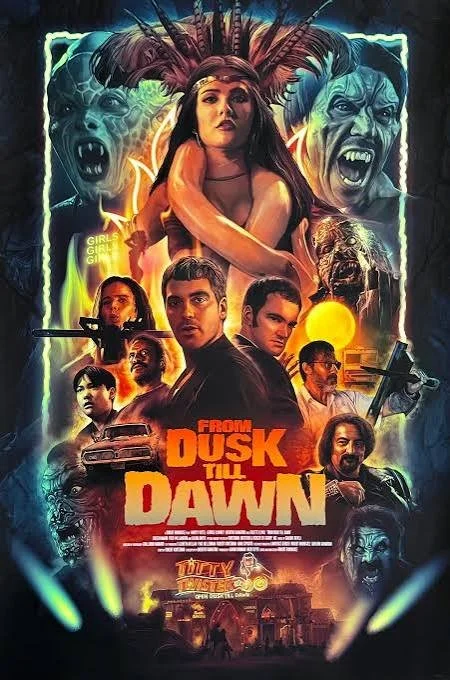
There are certain films that don’t just play—they possess you. They slide under your skin, rearrange your sense of logic, and whisper, “You’re mine now.” For me, From Dusk Till Dawn was one of those cinematic hauntings.

It began like a crime story—two brothers on the run, smoke curling from the barrel of every bad decision they’ve ever made. And then—because this is Quentin Tarantino’s world—reality split down the middle like a desert mirage. Out spilled blood, tequila, and chaos.

I admire Tarantino’s tenacity, truly. He creates with the fearlessness of someone who’s already been cursed and decided to dance anyway. His films aren’t about logic—they’re about rhythm. Pulse. He builds worlds that shouldn’t make sense but somehow do, because he wills them to. Watching his madness from a distance feels like watching lightning from a safe place: you’re in awe, but you know better than to get too close.

And yet, I can’t help but linger in the glow. There’s something hypnotic about Clooney’s calm against Quentin’s manic storm—two forces colliding until the screen erupts into fangs and fire. The moment Salma Hayek slithers onto that stage, you realize: you’re no longer in a movie. You’re in a fever dream directed by chaos itself.

But that’s the thing about horror—it’s not just about monsters or blood. It’s about surrender. From Dusk Till Dawn taught me that the most terrifying, intoxicating stories live where genres collide—where the crime scene meets the crypt, and the living become legend.

I watch it again and again, not for comfort, but for communion. Each time the desert opens and closes, I feel the same pull—to drive toward the edge of reason and stay there awhile. To honor the madness that makes the art, and the art that makes the madness.

So here’s to Quentin.

The architect of anarchy, the poet of pulp.

You made horror seductive, and chaos cinematic.

🩸 Forever yours in the dark,

Hellah Horrah, Mistress of the Night
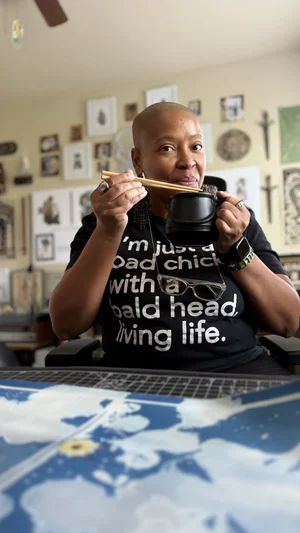
Tya Alisa Anthony

Tya Alisa Anthony is an American artist, photographer, writer, and independent curator whose work explores memory, mythology, ancestry, and the quiet ways people leave themselves behind in the objects they touch. For more than twenty years, her practice has existed at the intersection of visual research, education, and cultural storytelling, investigating resilience through the body, the landscape, historical archives, and the natural world.

Working across photography, collage, cyanotype, botanical collections, handmade books, and mixed media, Anthony approaches each body of work as an evolving archive rather than a finished statement. She is drawn to weathered photographs, heirlooms, medicinal plants, folklore, ritual objects, forgotten architecture, and the symbolic language that connects cultures across time. Her work asks how identity is preserved, transformed, and remembered.

Alongside her studio practice, Anthony has spent more than two decades building educational programs, exhibitions, and community-centered initiatives that expand access to the arts. Her leadership has helped shape institutions, mentor emerging artists, develop sustainable systems, and create spaces where creativity becomes a lifelong practice rather than a privilege.

Anthony’s artwork is included in the permanent collections of the Denver Art Museum and the Museum of Contemporary Art Denver’s Octopus Collection. Her work has been exhibited nationally and is held in numerous private collections.

She is currently creating Organic Tarot, a 78-card hand-collaged tarot deck and accompanying memoir that intertwines mythology, autobiography, botanical symbolism, and the archetypal journey of transformation. The project reflects the central thread running throughout her career: that art is not simply something we make—it is a way of understanding ourselves, preserving what matters, and leaving a map for those who come after us.

http://www.tyaanthony.com
Previous
Previous

Hellah’s House of Horror: Whispers in the Walls Featuring: The Others

Next
Next

Hellah Horrah: “Scooby-Doo and the Headless Specter” – Haunted Mansions, Funky Fears, & the Groove of Mystery